In the closing moments of the week, there were great new music videos to emerge from the camps of Erin Tobey, Big Eyes, Death Grips, Sewage Farm, And The Kids, and The Holy Circle. As good as those all were — and they were quite good — they simply couldn’t match the allure of personal history attached to this post’s featured clip. The very first Heartbreaking Bravery post centered on an Audacity music video. Now, more than 900 posts and nearly three years later, the band’s offered up another strong clip for a Hyper Vesselshighlight.
In the time that this site’s been running, I’ve been afforded several unique opportunities. One of those was working doors for one of Brooklyn’s finest venues, Baby’s All Right, which is the setting for Audacity’s latest clip, “Not Like You”, giving the whole affair an oddly meaningful bent. Baby’s iconic backdrop always lent the venue a uniquely cinematic appeal that often seemed to energize the acts on stage and this Brendan McKnight-directed clip utilizes that trait to its advantage.
Audacity are a band that’s thrived on conjuring up excessive amounts of energy since their earliest releases and have honed that particular skill set into something resembling concentrated weaponry. “Not Like You” is a surging track and the editing for its accompanying visual treatment matches that velocity to perfection, creating a high-impact punch that leaves an intentional mark.
Simple, effective, and embracing an honest sense of genuine fun (something that’s been noticeably absent from the majority of recent releases), “Not Like You” distills the band into what may prove to be a definitive piece. Manic, sharp, and surprisingly forceful, “Not Like You” is practically a victory lap for a band that’s been creating the type of art this site quite literally used as a foundation. Taking all of that into account, it’s nearly impossible to not revel in the sheer amount of joy on display.
Watch “Not Like You” below and pick up Hyper Vessels here.
Really, though, ever since Sub Pop’s announcement of their newest acquisition, this day has all but belonged to LVL UP. The band’s been working on their full-length follow-up to Hoodwink’d— this site’s pick for 2014’s Album of the Year — steadily for well over a year. Today, they unveiled the first track to be heard from that record, which will be titled Return to Love, with the perpetually shifting “Pain”.
Easily one of the finest songs Mike Caridi has contributed to the band to date (which is no mean feat), “Pain” is simultaneously one of the band’s most ambitious and arresting songs, demonstrating the breadth of their expanded scope in one fell swoop. Opening with a melancholic ambient swirl, “Pain” quickly ups the tempo and quickly begins presenting scathing, intimate questions like “where is the one who loved you, unconditionally?” and never lets down the intensity for a moment.
Ultimately, the song settles into the self-defeating mantra of “Never Find Love” before a volcanic eruption of feedback, distortion, and noise subsumes the song and quickly transforms it into a seething maelstrom of formidable power, reaching a level of darkness of which their most recent release — the excellent Three Songs EP — hinted towards. The quartet really lays into that final section during their sets (“Pain” has been a live staple for some time) and tap into some intangible quality that seems to elevate them as a unit, locking into some sort of terrifying trance and playing off of each other with startling precision.
“Pain”, likely more than most of their recent songs, pays homage to the band’s past while remaining determined to look towards the future. In striking that balance, LVL UP has managed to produce a song that does more than justify their Sub Pop signing, set up Return to Love‘s release, and remind people of why they came to be such a force. It becomes a transportive experience that nears moments of transcendence. Should the rest of Return to Love live up to the standard set by its first single, the band may find themselves following up a miniature masterpiece (Hoodwink’d) with the real thing.
Listen to “Pain” below (and watch a slightly blown-out video of the band running through an earlier version of the song last year at Palisades below the embed) and pre-order Return to Love from Sub Pop here.
Littler, Mass Gothic, Kino Kimino, Ty Segall, Henry Chadwick, Angel Du$t, Little Scream, and Talons were responsible for all but the last of the great music videos to emerge over the course of this site’s mini-hiatus. After being gone for nearly two weeks (thanks to both other musical obligations and preparation work for an upcoming feature on this very space), there were quite a few titles to consider. Ultimately, this final music video spotlight allotted to that stretch of time went to perennial site favorite Courtney Barnett (and her excellent new video).
After experiencing a massive breakout year that saw Barnett do everything from hosting SNL to being nominated for an overdue Grammy, the expectations for any new release for the songwriter have been set extraordinarily high. Thankfully, Barnett’s had a surprisingly long history of avoiding literally any form of disappointment and the brilliant Sunny Leunig-directed video for Sometimes I Sit And Think, and Sometimes I Just Sit‘s invigorating lead-off track is no exception.
Opening the clip on a tongue-in-cheek discussion carried out by Sleater-Kinney sets a lively pace both for the clip’s narrative and for the astonishing amount of cameos packed into the sub-six minute running time. Not soon after the coy cold open, Barnett takes up the titular role and Keunig sets about dismantling any expectations that decision may bring.
Apart from one legitimately breathtaking sequence of relative quiet that cuts away from the song completely, “Elevator Operator” exudes a kind of surprisingly specific irreverence and well-meaning snark that’s proven to be a Barnett specialty. Not long after that staggering moment of existentialism — which is anchored by an impressive performance from Barnett — “Elevator Operator” slides right back into its natural groove, cementing its status as a more-than-worthy addition to Barnett’s enviable output.
Watch “Elevator Operator” below and pick up a copy of Sometimes I Sit and Think, and Sometimes I Just Sit here.
Last night, this site started humming along again, focusing in on the best pieces to have emerged during its short absence from regular coverage. Today that mode will continue until Heartbreaking Bravery’s once again caught up to the current release cycle. To get to that point, there’ll be two more posts featuring music videos and two featuring full streams. This post’s dedicated to the former, which included strong releases from Batwings Catwings, Metronomy, Yassassin, Haux, Death Grips, Adam Torres, Chet Vincent & The Big Bend, and The Julie Ruin.
For the featured spot, this time around, there’ll be a brief step outside of normalcy to discuss an act that was monumentally important in shaping the foundation of this site: Okkervil River. After discovering the band’s early discography, I hit a point of near-obsession that was primarily driven by bandleader Will Sheff’s approach to songwriting. He was one of the first songwriters to successfully bridge nearly all of my core interests into the narrative threads of Okkervil River’s albums (especially The Stage Names, which I still regard as my favorite album of all time).
In Sheff’s songs, no matter what point of view he was utilizing or adopting, there was always a very apparent empathetic, humanist approach that anchored the proceedings. For all the bruises, damage, and fatal flaws of the protagonists and antagonists that so vividly littered the band’s works, there was an opposing, near-paradoxical beauty afforded to those subjects.
Over time, the band accumulated a great deal of critical acclaim but never seemed to break through to the massive audience they deserved, even as many of their lesser contemporaries were swept into those realms. It was around that time where I began to fully realize the divide between uncompromising artistry and the specific, tempered appetites of those greater throngs.
Whether it was Okkervil River’s cleverness, fierce intelligence, tendencies towards intellectually challenging narrative devices, or the intimidating density of their work that prevented them from securing greater fame is ultimately irrelevant. What matters is that their music struck a very deep chord with a large volume of people who, in turn, latched onto the band’s works with the kind of feverish admiration that the vast majority of bands can only ever hope to achieve.
Around that time was when I started formulating a commitment to the band’s that never got their due, forming the seed of an idea that would eventually become Heartbreaking Bravery.
After the period of time where their specific brand of defiantly subversive, strings-and-horns adorned genre-hybrid tapestries began to recede in the greater public’s respect and opinion, they’d already begun experimenting with a more oblique approach to their craft. While that more experimental-heavy era of the band essentially transitioned them out of that particular scene with their inimitable vision intact, several of the bands that surrounded them before that time fell to the wayside, cruelly discarded by a society that’s overly concerned with things that are decisively of the time and rarely concerned with the things that could be qualified as timeless.
That’s the source of the astonishing amount of emotional pull that’s present in the band’s latest track, the quietly devastating “Okkervil River R.I.P.”, which ostensibly laments a set period of Sheff’s life — one that’s inextricably informed by his main vehicle — and greets those memories with a forlorn respect and deep understanding. In a recently released music video that stars Tim Blake Nelson, Sheff once again takes on a directorial role and imbues the visual presentation with an air of the kind of sadness that never tips into regret.
It’s a bold work with a strong central performance that feels like an act of small, purposeful bravery despite its lingering resignation. In some ways, “Okkervil R.I.P. is a surprisingly difficult watch and in others, it’s deeply reassuring. However it’s viewed, it retains the sense of beauty that made the band such a compelling act at the outset of their career. That they’ve weathered as many storms as they have and still managed to come out with a vital — possibly even necessary — piece in their discography is nothing short of a triumph.
For those looking for materials to inform the clip even more, the characteristically poignant statement Sheff issued to preview the band’s forthcoming record, Away, can be read in full below.
The new Okkervil River album is called ‘Away’. I didn’t plan to make it and initially wasn’t sure if it was going to be an Okkervil River album or if I’d ever put it out. I wrote the songs during a confusing time of transition in my personal and professional life and recorded them quickly with a brand new group of musicians.
I got together the best New York players I could think of, people whose playing and personalities I was fans of and who came more out of a jazz or avant garde background, and we cut the songs live in one or two takes – trying to keep things as natural and immediate as possible – over three days in a studio on Long Island that hosts the Neve 8068 console which recorded Steely Dan’s Aja and John Lennon’s Double Fantasy. I asked Marissa Nadler to sing on it and got the composer Nathan Thatcher to write some beautiful orchestral arrangements, we recorded them with the classical ensemble and then I mixed the record with Jonathan Wilson out in Los Angeles.
2013-2015 had been a strange time for me. I lost some connections in a music industry that was visibly falling apart. Some members of the Okkervil River backing band left, moving on to family life or to their own projects. I spent a good deal of time sitting in hospice with my grandfather, who was my idol, while he died. I felt like I didn’t know where I belonged. When there was trouble at home, a friend offered me her empty house in the Catskills where I could go and clear my head.
New songs were coming fast up there, so I set myself the challenge of trying to write as many as possible as quickly as possible. I wasn’t think about any kind of end product; the idea was just to write through what I was feeling, quickly and directly. Eventually, I realized I was writing a death story for a part of my life that had, buried inside of it, a path I could follow that might let me go somewhere new.
“Okkervil River R.I.P.” and “Call Yourself Renee” are good emotional transcriptions of that time. I wrote the latter on psylocibin mushrooms on a beautiful afternoon in early fall in the Catskills. I wrote “The Industry” quickly after getting some bad news. “Comes Indiana Through the Smoke” is an anthem for the battleship my grandfather served on during the Pacific Theater of World War II. Before becoming a private school Headmaster, my grandfather was also a jazz musician; he paid his way through college as a bandleader, toured with Les Brown and His Band of Renown, and spent summers playing a residency at a NH lakeside gay dance club called The Jungle Room that kept live monkeys in the basement. (You can hear his actual trumpet on this song, played by C.J. Camarieri from yMusic.)
“Judey on a Street” is a love song, sunny but written late at night when the woods are maximum spooky. We cut “She Would Look for Me” pretty shapelessly, with a lot of improvisation, and it’s also a love song. “Mary on a Wave” is about the feminine aspect of God but is in a very masculine tuning: DADDAD. It’s also a love song. I wrote “Frontman in Heaven” in an obsessive three-day streak of writing for 14 hours, going to bed, getting up and writing again. It wasn’t a pleasant experience. I wrote “Days Spent Floating (in the Halfbetween)” by just jotting down the first sentence that popped into my head every morning in October immediately after I opened my eyes. At the end of the month I had a finished song. It was recorded as an afterthought as the last thing we did when they were about to kick us out of the studio. You can hear me flub some lyrics. But one take and we had it.
I think this record was me taking my life back to zero and starting to add it all back up again, one plus one plus one. Any part that didn’t feel like it added up I left out. Weirdly, it was the easiest and most natural record I’ve ever made. More than any time in my life before, I felt guided by intuition – like I was going with the grain, walking in the direction the wind was blowing. The closer it got to being finished, the more the confusion I’d felt at the start went away. It’s not really an Okkervil River album and it’s also my favorite Okkervil River album.
Watch “Okkervil River R.I.P.” below and pre-order Away from ATO here.
Tuffy, TERRY, CuckooLander, Soft Fangs, Valley Queen, Cheena, Suuns, and Hot Flash Heat Wave were just a small handful of the bands responsible for releasing exceptional music videos over the past two weeks. While all of them were worth watching, it was the visual accompaniment for Doe‘s recent standout “Sincere” that earns this post’s spotlight.
One of the many reasons for Doe’s artistic success has been their willingness to subvert expectations. Whether those might be the limits of their genres or even in their instrumental approach (two guitarists, no bassist), they’ve continuously excelled in winking at normalcy. Now, they’ve applied that approach to the music video format and the results are both endearing and massively entertaining.
In “Sincere”, the band experiments with a visual depiction of malaise, the somewhat tired trope of grossout food footage, and even something as subtle as ratio presentation. For a clip where there’s ostensibly nothing happening as far as a linear narrative thread is concerned (apart from the meditation on how repetitive and mundane life can be), that’s an impressively complex setup.
Mixing in low-grade special effects, strong visual composition, and crisp editing, “Sincere” is progressively elevated throughout its overall running time. As with all great clips, the song and the video inform each other, operating in a symbiotic relationship with virtually no drawback. As the band members dispassionately mime the words to the song in an effectively tongue-in-cheek runner, the Andrew Northrop-directed clip capitalizes on a modicum of momentum to hit a climactic section that involves the band remaining blasé while a variety of odd things happen with their food selections.
It’s a humorous moment, elevated by the band’s impressive deadpan performances but it’s overshadowed by the last section of “Sincere”, which takes a sharp left and sees guitarist/vocalist (and A Year’s Worth of Memories contributor) Nicola Leel breaking character and dissolving into laughter before rapidly cutting to a series of loose chaos and finally settling on a short vacuum clean-up sequence.
In those moments, “Sincere” transforms from an entertaining curiosity into a legitimately great video. By pulling back the layers of conventional expectation that’s normally applied to the type of clip that’s typically so aggressively straight-laced, Doe open up an invigorating new territory. It’s a wildly satisfying reveal that paints the entirety of “Sincere” as both radical deconstruction and loving homage. In short, it’s perfectly, unequivocally Doe.
Watch “Sincere” below and pre-order Some Things Last Longer Than You from Old Flame here.
Likely knowing they’d have to live up to their strongest song to date, Parquet Courts turned in a clip that centered on puppets that boasted an intangible, human quality that makes “Human Performance” at once endlessly fascinating and deeply unnerving. It’s as if the band, through some unholy miracle, found the way to perfectly visualize the most deep-seated neuroses that informs the song. There’s a certain Lynch-ian quality to the proceedings, managing to be painfully grotesque and undeniably human all at once.
As good as “Human Performance” — easily one of this year’s best songs — was on its own, the clip manages to complement it so effectively that it creates a symbiotic relationship with each format heightening the other. From the song’s resigned delivery to the video’s frank depiction of late-life sexual exploration, everything syncs up in a transcendental tapestry of repressed emotions. In both cases, “Human Performance” is a meditation on what it truly means to be human and all of the limitations that accompany humanity’s frequently cruel realty.
It’s a video that’s proven to be impossible to shake and a watch that practically demands revisits. Bold, original, and even brave, “Human Performance” is a cogent reminder of the artistry that can be granted to — and even defines — the most mundane, trivial details of life. Since it’d be nearly impossible to capture the overwhelming amount of sheer feelings that runs through every single frame of the video, I’ll just shut up and let the clip speak for itself.
Watch “Human Performance” below and pick the record up from Rough Trade here.
Psychopomp, one of this year’s most pleasant surprises, put Japanese Breakfast — a project spearheaded by Little Big League‘s Michelle Zauner — on the map. The record was partially born from a tragedy that Zauner wrote eloquently about in the very first entry for the A Year’s Worth of Memories series. “Jane Cum”, another in a string of impressive videos from the record, continues to perfectly match Japanese Breakfast’s most cinematic sensibilities with House of Nod’s very specific vision, anchored once again by the deft directorial touch of Adam Kolodny.
Kolodny imbues “Jane Cum” with a B-grade slasher flick aesthetic, centering in on a narrative that involves a mysterious coven, ambiguous motivation, and unerring commitment. As always, it’s a beautifully lensed clip, elevating a continuously progressing tension to heights that near the unbearable. Appropriately, the clip never once loses a sense of mystery, even in its ultimate reveal a host of questions remain. All of the actors involved (including photographer Stephanie Griffin and Cadet Kelly’s Gabriela June Tully Claymore) give nuanced performances.
Beautifully paced, undeniably driven, and spectacularly composed, “Jane Cum” manages to easily climb the scope from notable to genuinely memorable. It’s a startling clip full of vivid imagery that owes debts to not just horror sub-genres but to classic film noir as well. At the center of it all is Zauner, injecting the affair with a sense of eerie calm that winds up being the clip’s definitive trait. Deeply compelling from start to finish, it’s a music video that provides a fine example of what can be achieved within the format under the right circumstances (and with the right collaborative partners). Take a deep breath and let its spell take you under.
Watch “Jane Cum” below and pick up Pyschopomp from Yellow K here.
Weaves were a focal part of most of this site’s coverage this week, so running yet another feature on the band may seem predictable but it’s entirely earned. Their latest music video, for the excellent album opener “Tick”, is a perfect representation of the exhilaration that Weaves so effortlessly generates. “Tick” was one of a handful of intriguing music videos to surface over the past 24 hours, a list that also boasts new material from The So So Glos, Melkbelly, Thrushes, Billie Marten, and Parakeet. Natural Child, The Hecks, CC Mose, Johanna Samuels, Adam Olenius, and The Saxophones all offered up strong new songs while Dentist, Lake Ruth, Pink Mexico, Show Me The Body, and The Guests all unveiled explosive full streams. Additionally, there was a two-song preview of the Husband Stitch’s upcoming self-titled EP and an important compilation from SRB Productions entitled Forever Beautiful: A Collection of Love for Orlando with all proceeds going towards the victims of the tragic events that transpired at Pulse earlier this week.
Each of those endeavors are worth undertaking (and, again, that compilation is both deeply important and frustratingly necessary) but in terms of new releases, this week belonged to Weaves. The band’s been on an incendiary tear recently, highlighting their run with the reveal of their extraordinary full-length debut. Now, they’re taking on the music video game with a clear-eyed ferocity and a surplus of focused determination. Opening with a tongue-in-cheek commentary on middle-aged malaise, “Tick” quickly ricochets into the artful weirdness that permeates throughout nearly every facet of Weaves’ outsize aesthetic.
“Tick” immediately kicks into full gear following the humorously droll introduction, with the song quite literally following the protagonist’s every move. Eye-grabbing visualizations propel the clip to absurd heights as it careens along, providing both absurdist tendencies and subtle, pointed commentary in spades. The whole thing is a massively entertaining thrill ride that recklessly careens along from start to finish, allowing its own substantial momentum to be its definitive trait. Most importantly, every aspect of “Tick” scans as truthful, imbuing the clip with a refreshing dose of unapologetic reality; people are weird, inherently lonely, and entirely capable of creating an environment that suits their most immediate emotional needs.
In the end, “Tick” stands as a testament to perseverance. Heartfelt, painfully honest, and equipped with a formidable bite, “Tick” also stands as a prime example of what can be achieved within the confines of the music video format. A beautiful accompaniment to one of the year’s most astonishing debuts, “Tick” finds the band continuing on an astounding level of near-perfection. Give it a watch (or several) and do something that feels necessary.
Watch “Tick” below and pick up a copy of Weaves here.
Emily Yacina has built a career out of reveling in a comforting softness, conjuring up tantalizing beds of sound and enveloping the listener with the blankets. There’s an inherent warmth in her work that becomes effortlessly inviting while simultaneously creating a pull that stems from a deceptive emotional intricacy. The Sophie Savides-directed video for “A Curse” — which is gorgeously lensed by Kelly Jeffrey — capitalizes on all of those elements with an enticing precision.
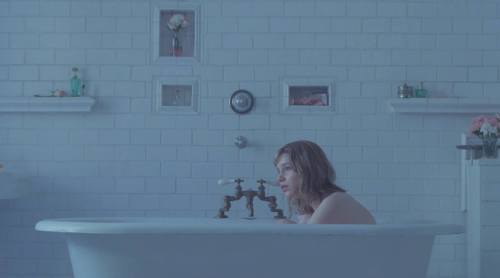
Opening on a shot of a forlorn Yacina in a bathtub set against a clinically white backdrop, the camera draws closer, slowly pulling us into her world. Two vases of flowers adorn that backdrop, offering signs of life that soon blossom as the perspective switches to Yacina’s POV which reveals that she’s submerged in a milk-like liquid that single flowers populate. Another perspective shift and the flowers are suddenly everywhere, as a wellspring of noises calmly enter into the track.
Yacina captivates throughout, delivering a startlingly poignant performance that speaks to her abilities as both a composer and a performer. As the clip progresses, the sincerity in Yacina’s songwriting grows clearer as she bravely conveys every emotion that carries “A Curse” with a poise that seems effortless. Eventually, the camera pulls back out in a cyclical reveal that underscores the pained loneliness that informs the narrative of “A Curse” in a moment of reserved devastation.
Overall, “A Curse” is a deeply felt, elegant entry into Emily Yacina’s already impressive body of work. Open, honest, and incisive, it’s perfectly demonstrative of what can be achieved with an idea, a strong team, and a wealth of conviction. In that sense alone, it’s inspiring. What makes it worthwhile extends beyond its underpinnings to its execution. “A Curse” is exceptional at every turn and winds up being a definitive portrait of a formidable artist. After a dip into “A Curse”, it’s proving to be nearly impossible to work up the resolve to leave.
Watch “A Curse” below and pick up Soft Stuff here.
While all of those titles are more than worthy endeavors worth ever single moment of investment that they’ll be given (and likely even more), Bueno’s latest track grabs this post’s headline. Over the past several years, Bueno has gain an extremely dedicated following that have granted them an almost cult-like status among their converts. “I Get Your Back” justifies that adoration with a calmness that nears the serene. Incorporating an off-kilter powerpop sensibility into their typical ’90s-indebted slacker punk approach pays massive dividends here, as the erratic propulsion of “I Got Your Back” leads it into the kind of near-transcendental territory that’s hard to forget.
Listen to “I Got Your Back” below and pre-order Illuminate Your Room here.





 Heartbreaking Bravery