A band that’s continuously brimmed with an indistinguishable intensity from the outset, Big Ups’ attack has grown refined over the course of a handful of records. All of them are teeming with cathartic releases and bear evidence that their understanding of their own dynamics has deepened over the course of that run. It’s an understanding that hits a new apex with “Imaginary Dog Walker”, the band using silence and restraint like a weapon, holding the listener hostage and forcing them to really listen.
Brash, abrasive, and extremely disquieting, “Imaginary Dog Walker” is a perfect demonstration of the band’s growth and a fearless monument to their formidable talent. Opening with a small sampling of glitch-pop, “Imaginary Dog Walker” quickly segues into the kind of forward-thinking hardcore that enlivened the band’s past two records (both of which stand as tall now as they did on the day of their release). Soon enough, the band’s back to masterfully navigating a creeping tension, the music acting as a lit fuse of a bomb that always seems like its a second away from detonating.
When “Imaginary Dog Walker” does work itself up into its first genuine frenzy, it’s hard to tell if it’s the moment of release or just the song playing an effective trick. In an impressive feat, that moment manages to belong equally to both outcomes, ushering in both a cavalcade of high-wire frustrations that erupt and a false ending, quickly cutting back into the quieter tendencies of the song’s opening stretch. All the while, the narrative waxes poetic on life and destruction, playing into the unpredictably vicious swings of the music with a honed precision.
In its final minute, the song becomes a towering behemoth, “we walk the dogs” is screamed over and over becoming more of a mantra than a chorus. All the while, the guitar work — which remains some of the most inventive in the genre — and the rhythm section collide into a bludgeoning force, conjuring up a hypnotic storm. It’s dark, it’s eerie, and it’s masterful, it’s also one of the best songs to come out of 2018. Lend it as many listens as possible.
Listen to “Imaginary Dog Walker” (and watch a live video of the song) below and pre-order Two Parts Together from Exploding In Sound.
Last week, sewingneedle unveiled the enigmatic music video for their excellent “feel good music” and today they’re following up that clip with the album opener of their forthcoming user error, “two three four”. The song exists in the same bleary vein as “feel good music”, finding ways to relentlessly attack from an extremely specific angle, as dark as it is energized, falling neatly in line with some of the finest acts on Exploding In Sound’s roster (Two Inch Astronaut, Kal Marks, Pile, etc).
“two three four” goes a long way in setting the tone for the band’s formidable user error, dropping the listener into a world of shadowy corners that give cover to lurking demons. The clean guitar tones add some enhancement to an already abrasive sensibility, allowing the moments of blistering distortion to gain even more magnitude. Half-open questions are cried out in nervous anticipation, directed at next to no one, the music surging underneath with the insistent counting tethering the entire affair back to the dreck of life’s monotony.
All of it congeals into a formidable piece of post-punk, elevated by its own commitment to noise. Intentionally ugly and undeniably compelling, “two three four” serves as a heavy reminder of the predetermined regulations we’re expected to navigate through our existence. It’s a song that has a lot on its mind and aptly conveys those thoughts using minimalist tactics in a clever twist, suggesting that operating outside of the lines can lead to memorably great results.
When the track races towards its finish, one thing does become abundantly clear among the songs frustrated uncertainty: sewingneedle are done existing in the background. This is a band that’s ready to make a statement by creating their own moment of reckoning. user error is that reckoning and “two three four” only hints at its astounding depths. While the record will arrive soon to address the curious in full, “two three four” is good company to keep. Leave it on repeat and let it play.
Listen to “two three four” below and pre-order user error here.
Last Friday offered an extraordinary outpouring of new records with several of those releases seeming poised to be legitimate Album of the Year contenders. While those records hit hard, Half Waif’s Lavender hit hardest. A handful of the record’s songs have been featured here already but it’s the cumulative effect of the record that elevates the songs from heartrending to heart-stopping.
Nandi Rose Plunkett, Half Waif’s fearless bandleader, wrote Lavender in the waning days of her grandmother’s life and found a way to preserve her memory in astonishing fashion with Lavender. Imbued with familial love and meditations on the joys and consequences of mortality, Lavender ceaselessly finds ways to grapple with heavy burdens through a series of open questions, some unanswerable. The examination process is one that becomes intimately familiar to anyone whose ever had to confront the death of a loved one and it’s not hard to read into Lavender as a personal reckoning from someone in the throes of that journey.
It doesn’t take long for the ghost of Plunkett’s grandmother to find a home in Lavender, appearing as early as the record’s breathtaking opener “Lavender Burning”. That specific song is a perfect introduction to the record as it marks a slight — but distinct and extremely important — stylistic shift for Half Waif, who move into a more subdued realm that’s enhanced by a re-dedication to introspection, more naked here than at any point in their discography.
“Watching my grandmother walking her garden, she’s lost her hearing does not notice the cardinal”, Plunkett sings, cardinal breaking up into lilting syllables as the memory overwhelms. It’s one of many small vignettes that litter Lavender‘s landscape, flowers dead and blooming. It’s not long before the burden of knowing sinks in and cries of “Is this all there is?” ring out over lush beds of synth and intuitive instrumentation. Confined to a confrontational solitude, Plunkett starts wrestling with existential autonomy: a sense of place, the weight of decisions, and the fear that accompanies free will.
All of these questions, all of these backwards looks and sideways glances are more immediate than any single narrative Half Waif’s presented in the past. They’re also by far the most gripping, as the music Half Waif has afforded these moments is their most expansive, textured, and ambitious to date, leaning hard into the band’s more ambient sensibilities. Lavender‘s rhythm section pulsates with purpose, reverberating throughout the record with the clear knowledge that the stakes here are legitimately life and death. From start to finish, it’s a fight for the means to survival.
If Plunkett’s grandmother is the foremost figure of Lavender, New York City and Plunkett herself aren’t too far behind. The relationship between the two, specifically, anchors some of the record’s most breathtaking stretches, including both “Lavender Burning” and “Back In Brooklyn”, which the songwriter penned an incredibly moving essay for over at The Talkhouse. “Back In Brooklyn” is a song that lands with exceptional force for anyone who’s ever been wrapped up by the titular city’s formidable being and goes a long way in laying out Lavender‘s gently beating heart.
Not coincidentally, the song resides in the album’s central stretch, arriving just after “Silt”, the two constituting Lavender‘s most breathtaking moment. It’s here where Plunkett comes nearest to breaking down completely, stretching out a hand for guidance, assurance, or even just a small moment of clarity in the fog of uncertainty. The closing moments of “Silt” offer up one of the record’s most haunting moments, an outro that beautifully segues into the painfully gorgeous “Back In Brooklyn”.
Everything that leads up to those two songs makes their back-to-back even more potent, the themes splintering apart into what feels like a million pleas, some from the city, some for the city, some from Plunkett, some for Plunkett’s own well-being. It’s here where Lavender finds its path to becoming transcendental. Those two songs combine to retroactively strengthen the songs that have preceded them while setting up one of the most memorable closing runs of the present decade.
It’s here where the allusions stop becoming guarded and are faced with no hesitation, Plunkett seemingly locked into a white-knuckle grip on the legacy of family, self-understanding, and the trials of knowledge. The latter of the three has one of the more potent dichotomies and that scale is explored through the framing of the former two. It’s that dynamic which makes the final quarter of Lavender so harrowing and so beautiful, the acknowledgment of the necessity of the scars and bruises that allow us to move forward towards our own destiny and towards the same fate that will take everyone we’ve ever loved.
Rather than waist time on hypothetical situations, Plunkett discards them in the service of realism and a commitment to the bravery the bandleader strives for on “Parts”. There’s a dissection of shame and anxiety in that song, one that resonates through to Lavender‘s end, before the tacit acceptance of the fearlessness required to continue existing. By the record’s end the only home Plunkett seems to have is forward motion, abandoning cities, clinging to friends, family, and lovers, doing whatever it takes to find a measure of peace in life’s restlessness.
Lavender‘s final verse acts as a summation of the themes Plunkett can’t escape through the course of the eleven songs and diverts them in a fruitless bid to forget what most of the record has exhausted itself in staring down before its final, heartbroken declaration: I don’t wanna know this/I don’t wanna know how this ends/In the grand scope of things/I know. It’s right then, in that last word, Lavender becomes complete. Not just a record about confronting death, Lavender is a record about the allowances of life, the difficulties that make it harsh, the people that make it worthwhile. In the end, when all is said and done, what’s left is the weight of knowing, and allowing it to sink to oblivion or float just a little while longer.
Listen to Lavender below (and watch a packet of live videos beneath that) and pick it up from CASCINE here.
The last week ended strongly, offering up an absolute treasure trove of full streams for a host of records that may find themselves being discussed again in December. Speedy Ortiz, Double Grave, Rachel Angel, Spielbergs, Holy Now, Anemone, Sibille Attar, Launder, Porlolo, and Grouper were all artists that played a part in that outpouring (as did the just-featured Forth Wanderers). Still, the focus of this post falls to an entry in a different format entirely: Snail Mail‘s elegantly crafted and surprisingly pointed clip for “Heat Wave”.
The solo project of Lindsey Jordan, Snail Mail has been making a series of incredibly smart decisions over the past year, including their partnership with Matador Records. Another one of those decisions was enlisting Brandon Herman‘s talents for the clip, allowing the filmmaker to handle directorial, editorial, and DOP duties with aplomb. The project and the filmmaker have delivered a carefully constructed metaphor for the importance of fighting for yourself, even in the face of unfavorable odds and seemingly insurmountable pressure.
“Heat Wave” finds clever ways to make its timely heft an incredible amount of fun (without sacrificing an ounce of integrity). Centered on Jordan, wrapped up in a hockey-centric escapist fantasy, “Heat Wave” refuses to pull punches throughout a range of exceptional moments, from an anxiety-inducing confrontation to some cathartic moments of unbridled rage. By the clip’s finale, Jordan’s made sure that absolutely nothing’s left on the rink and that the songwriter can escape with both contentment and a touch of pride.
Uplifting and upsetting in turns, “Heat Wave” is an effective portrayal of the themes frequently deconstructed by the clip’s protagonist. It’s a gentle reminder of societal culpability and just as effective as a demonstration of how our own convictions are necessary for not just advancement but survival. The song’s a new highlight for the project and the clip is its best to date. We should all be grateful that Snail Mail’s being given the chance to accelerate.
Watch “Heat Wave” (and a live performance of the song) below and pre-order Lush from Matador here.
In the closing stretch of last week records from Karen Meat, Blues Lawyer, DEEREST, Mind Monogram, and Say Sue Me all found ways to make an impact. Another piece of music that found release in that time was Yowl’s “Warm (in the Soft White Fire of Modern Living)”, a dynamic slice of post-punk that veers back and forth between a probing, mid-tempo verse and an extremely explosive chorus that suffuses the song’s narrative with some crushing realism.
Shades of Pavement are as easy to pick out as references to their contemporaries in Car Seat Headrest, but something about “Warm (in the Soft White Fire of Modern Living)” feels singular enough to separate Yowl from any comparisons to those two acts (or any number of Flying Nun projects). There’s genuine conviction in this songwriting and the band have sculpted a composition that allows both the lyrics and music to heighten each other, rather than taking a more ancillary role. It’s an incredible track that finds Yowl well on their way to entering bigger discussions. “Warm (in the Soft White Fire of Modern Living)” is the kind of statement track that deserves — and seems poised to earn — a much wider audience.
Listen to “Warm (in the Soft White Fire of Modern Living)” below and keep an eye on this site for more details on the band in the future.
“Kicking In”, an album highlight from Recreational Hate, finds the band expanding on their classic country influences, conjuring up the kind of wide-open imagery perfectly suited to a music video. The band capitalized wisely, moving to the desert for a satirical deconstruction of the music video process. It’s an exceedingly clever conceit that takes a turn towards the end and offers up a heartwarming resolution to the difficulties and interpersonal conflicts — and petty resentment — that can drive wedges between cast and crew on adventurous shoots. A note-perfect testament to the band’s legacy, “Kicking In” is about as perfect of a music video as Lemuria could have crafted. Just like the band’s music, “Kicking In” is a welcoming invitation to come in, get warmed, and enjoy the party.
Watch “Kicking In” below and pick up Recreational Hate from the band here.
Teeming with imagery that hosts a handful of connections to other iconic visuals, the band completely eschews any inhibitions of operating on anything other than a ridiculously grand scale. That grandeur pays dividends, ushering in a bold new era for a band that once seemed content to operate on nearly anarchic terms. In “The Day The Music Dies” they take their mission to the church, light some fires, present a united front, and preach from a pulpit.
All of the confrontational immediacy is escalated by the track itself, which is lent a surprising amount of heft by some incredibly effective horn charts. Fascinating at just about every turn, riddled with allusions to Gothic-tinged entertainment (Paul Thomas Anderson’s There Will Be Blood acting as a more recent reference point), “The Day The Music Dies” finds Iceage comfortable in continuing to expand their boundaries, making Boundless — the band’s forthcoming full-length — one of the more intriguing prospects on the release calendar. The ride to get to that release, should “The Day The Music Dies” be a solid indicator, will be worth taking.
Watch “The Day The Music Dies” below and pre-order Beyondless from Matador here.
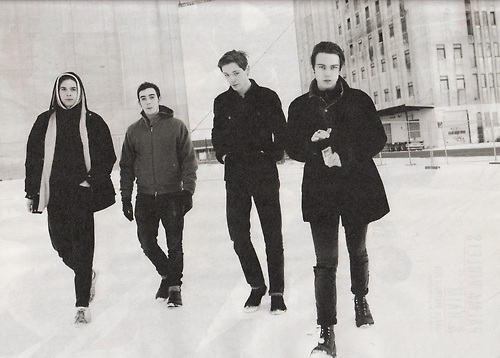
Following the scintillating “PPP”, Big Ups have now stoked the excitement for their forthcoming Two Parts Together even further with “Fear”. The song itself is the band at their most aggressively simple, relying on their use of restraint as a means of aggression with characteristically sterling results. Capitalizing on the song’s cumulative effect is the accompanying music video, cut together by drummer Brendan Finn using performance clips from the band culled from various sources and footage that came from the band member’s through several tours [Disclaimer: Heartbreaking Bravery footage of the band performing at Palisades is included in the clip].
As is the case with every Big Ups track, the intensity when the song reaches its apex is blistering and its quieter moments are as arresting as ever, the dichotomy surges breathing some life into the clips as they flicker on the screen. There are times where “Fear” almost feels like a statement about the band’s endurance, versatility, and longevity, yet their own legacy never becomes an overwhelming focal point. Instead, there’s enough freewheeling sensibilities and uncertainty that it subverts the trap of becoming a referendum and simply settles on being a living testament to their present power.
“Fear” is effective, efficient, and more than serves its purpose: anyone that listens or watches the clip has been served noticed that something menacing is lurking just around the corner. All we have to do is wait until May 18.
Watch “Fear” below and pre-order Two Parts Together from Exploding In Sound here.
A snappy sub-three minute track, “Red State” showcases both Angelella’s endearing narrative voice and musical control. Everything on “Red State”, despite its shaggy presentation, feels concise and deliberately articulated (including its gruff sensibility). It’s a perfect piece of the kind of basement pop this place was built to celebrate, something that seems destined to fly under the radar but hit a small group of targets with incredible force. Clever, fun, a little bit bleak, and immensely enjoyable, “Red State” isn’t just good enough to liven up any party where it gets played, it’s good enough to be remembered.
Listen to “Red State” below and pre-order Road Movie here.
Derrick Belcham takes the reins for the “How Simple” clip, which is a joyous celebration of identity and an homage to classic films (notably, the golden era of the movie-musical). The video also puts guitarist/vocalist Frances Quinlan front and center, marking an intriguing first for the band. Quinlan’s boundless charisma and magnetism as a perform has long been a selling point of the band’s scintillating live show but they’ve never allowed themselves such a visual spotlight in the visual release format.
The wait pays tremendous dividends here, Quinlan’s presence coming off like a sustained flash of lightning, cleverly elevated by the clip’s single-spotlight framing. All eyes are on Quinlan as the songwriter guides us through what could be a manic breakdown, a morning routine, or an extended moment of solitude. No matter which way the clip’s narrative is spun, the truth of it manages to speak volumes, punctuated by what very well wind up being the line of the year in “don’t worry, we will both find out, just not together.”
Impromptu dance parties break out, cereal gets eaten, and different figures find ways to come into focus, but when “How Simple” begins receding, those faces are left peering in from outside, with that lone spotlight still on Quinlan. It’s a moment that’s both sobering and hopeful, coming across as a testament to a well-earned understanding of the importance of self-care. Even when everything falls apart or is splintering at the seams, there are still ways to center yourself. Sometimes all it takes is the knowledge that you’re always free to dance around and pour yourself a bowl of cereal.
Watch “How Simple” below and pick up a copy of Bark Your Head Off, Dog here.







 Heartbreaking Bravery